Cable railing hardware is the group of fittings and accessories used to terminate, attach, tension and service the cable runs between the project's posts. This includes cable railing fittings, cable railing tensioners and swageless cable railing hardware for compatible Quick Lock installations. The correct choice depends on more than appearance: cable construction, cable diameter, post material, stair or level geometry, mounting method and connection workflow must agree.
MR.RAIL organizes its standard hardware around those decisions. Quick Lock families provide a push-in, swageless connection for matching 1×19 stainless steel cable. The Swage family uses a permanent crimp connection and accepts matching 1×19 or 7×7 cable. Each application type is offered in size-coded families for 1/8, 5/32 and 3/16-inch cable.
Buyers focusing on the adjustable cable-end hardware can use the dedicated cable railing tensioner selection guide to compare wood-post, metal-post, stair, level, surface-mount and through-post families.
This page is a product-selection guide, not an engineering approval or a substitute for the current installation manual. Confirm the selected model, approved dimensions, tools, quantities and project requirements before ordering or installing any component.
What does cable railing hardware include?
In a purchasing conversation, “hardware” may refer to tensioning fittings, non-tensioning ends, mounting bases, through-post bodies, washers, threaded parts and service accessories. It does not automatically mean that cable, posts, handrail, tools or every component for a complete guard system is included.
MR.RAIL's standard online range includes cable tensioners, corresponding cable ends, Quick Lock and Swage fittings, and matching release tools. Their functions differ: a non-tensioning Ending terminates and secures the cable, while a Tensioner provides the adjustment for cable tensioning. Mounting parts connect the selected assembly to the post arrangement; release tools service compatible Quick Lock connections before final tensioning. Not every hardware item adjusts cable tension.
A cable run can use Ending + Tensioner or Tensioner + Tensioner, depending on the customer's actual installation, adjustment access and compatible components. The original MR-01 installation manual illustrates an Ending and a Tensioner; the MR-06 installation manual illustrates tensioner assemblies at both ends. These are reference configurations, not an exhaustive list of permitted combinations. See the tensioner guide for the end-function distinction.
MR.RAIL supports B2B sourcing through standardized products, compatible component combinations and project-specific customization. Start with the installation requirements, then send the proposed configuration for review. Confirm nonstandard combinations and customization requirements rather than assuming that all fittings are interchangeable or that every project must use a fixed pair.
That is why a generic search for cable railing fittings should lead to a specification check rather than an instant model assumption. Two stainless steel fittings can look similar in a small product image while differing in cable construction, diameter, post connection or stair-angle function.
Start with the connection method
Swageless and Swage describe how the cable connects to a fitting, not whether that end is an Ending or a Tensioner. Choose the connection method and the end functions separately. Push-in cable locking is not the same step as final cable tensioning.
Quick Lock swageless hardware
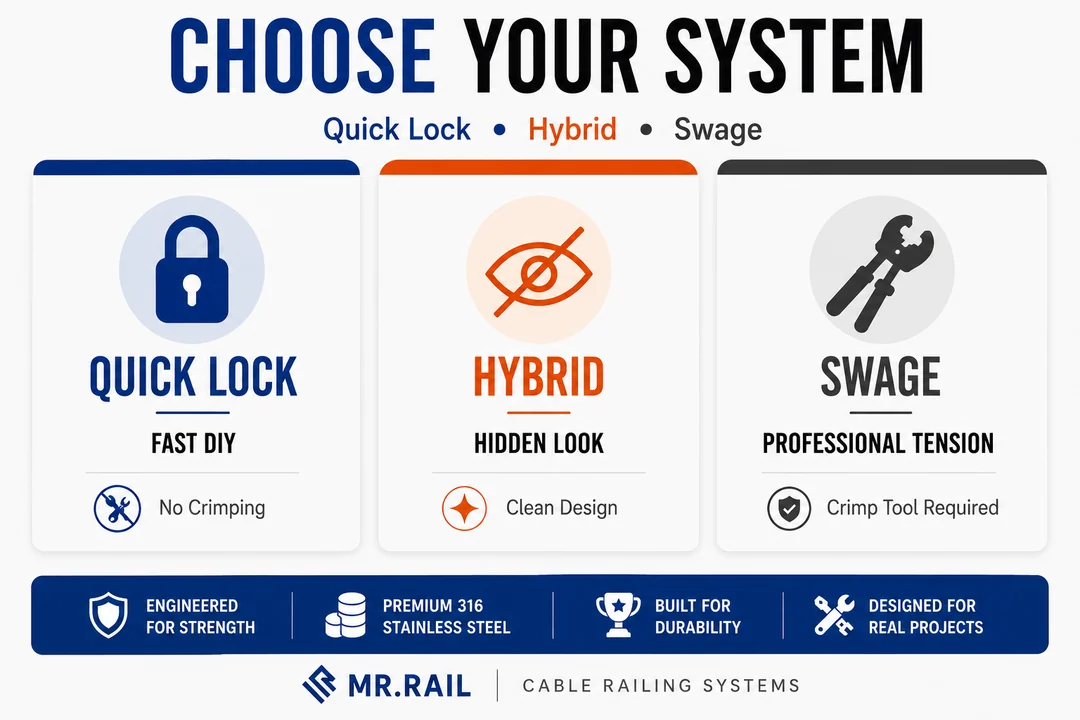
MR.RAIL Quick Lock is a push-in connection. The prepared cable is inserted fully into the fitting, where internal one-way grip jaws engage it. A hydraulic crimper is not required on the Quick Lock connection. This can reduce specialized tooling at that end, but it does not remove the need to measure, cut, prepare posts, install components and complete final tensioning with the approved tools.
Quick Lock accepts 1×19 stainless steel cable only. It is available for wood-post, metal-post, surface-mount and through-post layouts across stair and level applications. Learn more about the mechanism in the Quick Lock technical guide.
Permanent Swage hardware
MR.RAIL Swage hardware uses a permanent crimped connection. The matching cable is inserted into the Swage section and compressed with the specified hydraulic crimping tool before final tensioning. The MR-08 / MR-18 / MR-28 family is a surface-mount wood-post system with swivel bases for stair or level runs and accepts matching 1×19 or 7×7 stainless steel cable.
Swage and swageless are installation categories, not interchangeable claims. A project that is already designed around a permanent crimp workflow may favor Swage; a project seeking a push-in connection for 1×19 cable may favor Quick Lock. Compare the workflows in the swageless versus Swage guide.
Match both cable construction and diameter
Diameter alone is not enough. A product request that says “1/8-inch cable” still needs the cable construction. MR.RAIL Quick Lock requires 1×19 cable. MR.RAIL Swage hardware accepts 1×19 or 7×7 cable in the matching diameter.
Construction is part of the fitting specification, not just a description of cable appearance. Check the cable supplier's label or specification against the selected MR.RAIL model and its installation instructions. Do not transfer another product's cable-compatibility rule to an MR.RAIL fitting or assume that matching diameter alone confirms compatibility.
MR.RAIL's size coding keeps the same application type recognizable across three diameters:
- MR-01 through MR-09: 1/8-inch family.
- MR-11 through MR-16, MR-18 and MR-19: 5/32-inch family.
- MR-21 through MR-26, MR-28 and MR-29: 3/16-inch family.
The fittings are size-specific. A model from one diameter family should not be treated as an adjustable replacement for another. Check the cable label or purchasing record and use the current model specification when preparing holes, threads, tools and cable ends. Use the cable railing fitting size guide to map 1/8, 5/32 and 3/16-inch cable to the correct model family.
Choose by post, run and mounting method
Once cable construction and diameter are known, classify the installation. Wood and metal posts use different attachment approaches. Stair and angled runs need hardware that follows the cable direction, while level runs use a straight configuration. Through-post hardware passes through the end post; surface-mount hardware attaches at the post face.
| Model families | Post | Run | Mounting |
|---|---|---|---|
| MR-01 / MR-11 / MR-21 | Wood posts | Stair and angled | Surface mount |
| MR-02 / MR-12 / MR-22 | Wood posts | Level and straight | Surface mount |
| MR-03 / MR-13 / MR-23 | Metal posts | Stair and angled | Surface mount |
| MR-04 / MR-14 / MR-24 | Metal posts | Level and straight | Surface mount |
| MR-05 / MR-15 / MR-25 | Wood or metal posts | Stair and angled | Through post |
| MR-06 / MR-16 / MR-26 | Wood or metal posts | Level and straight | Through post |
MR-08 / MR-18 / MR-28 cover the standard surface-mount Swage choice for wood-post stair or level runs. MR-09 / MR-19 / MR-29 are release tools for matching Quick Lock size families; they are accessories, not tensioners.
The table groups standard application families; it does not prescribe a mandatory fixed pair for every run. Where a project combines different post conditions or changes direction, list each run separately and identify the required Ending + Tensioner or Tensioner + Tensioner configuration. Select compatible components for the actual geometry and access, with project-specific requirements confirmed during review.
Use the dedicated wood-post versus metal-post fitting guide to compare the post interface, mounting choices and standard model families before preparing a takeoff.
Then compare stair versus level fittings and through-post versus surface-mount hardware to finish the application check.
Separate hardware selection from package scope
Search phrases such as “cable railing hardware kit” and “cable railing system” are useful starting points, but they do not define package contents. A hardware family may be sold in paired components or project quantities without automatically including cable, posts, handrail, drill bits, cutters, crimpers or every installation accessory.
For an accurate quotation, ask for the contents in writing. State the number of cable runs, exact model family, cable diameter and construction, required quantities, packaging format and whether cable or tools are being requested separately. For OEM, wholesale or private-label work, also specify labeling, inner packaging, carton requirements and any approved documentation needed with the order.
This prevents two common purchasing problems: comparing offers that contain different components, and assuming a product photograph represents a complete system. MR.RAIL confirms price, MOQ, packaging, carton details, weight, trade terms and quotation validity for each inquiry.
Eight details to include in a hardware inquiry
- Cable diameter: 1/8, 5/32 or 3/16 inch.
- Cable construction: 1×19 or 7×7.
- Post material: wood or metal.
- Run geometry: stair or angled, or level and straight.
- Mounting method: surface mount or through post.
- Connection method: Quick Lock or Swage.
- End configuration and quantity: Ending + Tensioner or Tensioner + Tensioner, with exact components, models and quantities by run.
- Commercial scope: standard packaging, OEM/ODM, private label or wholesale requirements.
Photographs and drawings are helpful when the post condition or mounting access is not obvious. They should support—rather than replace—the written cable and hardware specification. Installation should follow the current model manual, and project design or local requirements should be reviewed by the responsible professional or authority.
Frequently asked questions
What cable works with MR.RAIL Quick Lock hardware?
Matching-diameter 1×19 stainless steel cable only. Confirm both construction and diameter before selecting a model.
What cable works with MR.RAIL Swage hardware?
Matching-diameter 1×19 or 7×7 stainless steel cable.
Can a cable run use a Tensioner at both ends?
Yes. A cable run can use an Ending + Tensioner or a Tensioner + Tensioner configuration, depending on the actual installation and compatible components. Swageless describes the cable connection, not the number of tensioning ends. Confirm the configuration, mounting access and component quantities for each run.
Which hardware is used for wood-post stairs?
MR-01 / MR-11 / MR-21 are the standard Quick Lock families for surface-mount wood-post stair and angled runs. MR-08 / MR-18 / MR-28 provide the standard wood-post Swage option with swivel bases for stair or level runs.
Are MR-09, MR-19 and MR-29 tensioners?
No. They are matching Quick Lock release tools for pre-final-tension cable adjustment or removal.
Does “hardware” mean a complete cable railing kit?
No. Package contents must be confirmed in the quotation. Do not assume cable, posts, handrail or tools are included unless they are listed.
Can MR.RAIL support OEM or private-label orders?
Yes. Send the product family, quantities, packaging, labeling and documentation requirements for review.