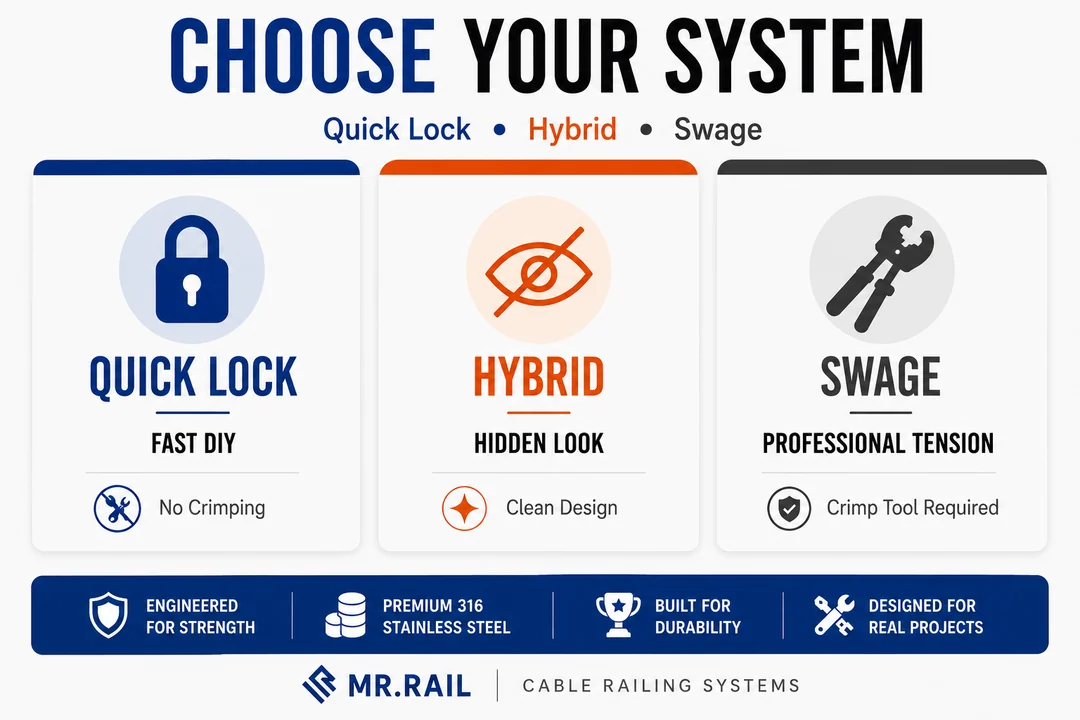
Short answer: Choose MR.RAIL Quick Lock for matching 1×19 cable when you want a push-in connection without hydraulic crimping at that end. Choose MR.RAIL Swage for matching 1×19 or 7×7 cable when you can follow the specified permanent crimping workflow. Neither connection is universally better: the exact fitting must also match the post, run and mounting layout.
End functions and project configurations
An Ending secures a cable end without tension adjustment. A Tensioner provides the adjustment for tensioning the run. Ending + Tensioner and Tensioner + Tensioner are both possible configurations, selected for the actual installation and compatible components.
Swageless and Swage describe the cable connection, not the number of tensioning ends. Push-in locking does not replace final tensioning.
Standard model layouts are reference configurations, not a requirement to buy one fixed pair. MR.RAIL reviews standardized products, compatible component combinations and project-specific customization. Confirm the cable, post interfaces, adjustment access, exact components and quantities before ordering.
Illustrated reference configurations:
Which MR.RAIL fitting and installation manual fit your project?
Use this model-family selector after confirming cable construction. Within each three-model row, the sizes are 1/8, 5/32 and 3/16 inch respectively. These are separate models, not one adjustable fitting.
| Project condition | Model family | Current instructions |
|---|---|---|
| Quick Lock, wood posts, stair runs | MR-01 / MR-11 / MR-21 | MR-01 family manual (PDF) |
| Quick Lock, wood posts, level runs | MR-02 / MR-12 / MR-22 | MR-02 family manual (PDF) |
| Quick Lock, metal posts, stair runs | MR-03 / MR-13 / MR-23 | MR-03 family manual (PDF) |
| Quick Lock, metal posts, level runs | MR-04 / MR-14 / MR-24 | MR-04 family manual (PDF) |
| Through-post Quick Lock, stair runs | MR-05 / MR-15 / MR-25 | MR-05 family manual (PDF) |
| Through-post Quick Lock, level runs | MR-06 / MR-16 / MR-26 | MR-06 family manual (PDF) |
| Surface-mount Swage, wood posts, stair or level runs | MR-08 / MR-18 / MR-28 | MR-08 family manual (PDF) |
Hybrid exception: MR-07 combines a Quick Lock end with a Swage end. It is available for customer-requested projects in 1/8 inch only and accepts 1×19 cable only. Its Swage end still requires crimping; there is no MR-17 or MR-27. See the MR-07 manual (PDF).
This selector summarizes MR.RAIL's confirmed product classifications and model-specific installation library, not independent comparative testing. Follow the selected model's instructions and approved project design; this guide does not establish structural capacity or code compliance.
The difference between swageless and swage cable railing fittings is not simply “easy” versus “professional.” The connection method changes the tools you need, the cable constructions you can use, and the decisions that must be finalized before installation. Post material, stair or level layout, cable diameter, and access behind the end post also affect the correct choice.
For the standard MR.RAIL range, the two connection categories to compare are Quick Lock and Swage. Quick Lock is MR.RAIL's push-in swageless system. Swage uses a permanent crimped connection. They are not interchangeable, and the correct choice depends on the cable and project layout.
This guide compares them without relying on unverified performance or cost assumptions.
What is the practical difference between swageless and swage fittings?
“Swageless” describes a cable termination installed without conventional swaging equipment. It does not identify a universal mechanism, cable compatibility rule or tension-adjustment function. For MR.RAIL, use the selected model's cable requirements and original installation instructions.
A swage fitting is secured by permanently compressing the fitting onto the cable. That process normally requires the specified mechanical or hydraulic crimping equipment and the correct die or tool setup for the fitting. Once crimped, the connection is intended to remain permanent.
The important buyer question is therefore: Which termination workflow fits the project, cable, available tools, and installer's plan?
MR.RAIL Quick Lock: push in and lock
MR.RAIL Quick Lock fittings use internal one-way grip jaws to hold the cable after it is fully inserted. No hydraulic crimper is required on the Quick Lock end. This reduces the specialized tooling required for that connection, but it does not eliminate the need to choose the correct model, prepare the cable end properly, follow the installation instructions, and complete final tensioning with the appropriate fitting.
MR.RAIL Quick Lock models accept 1×19 stainless steel cable only. They are available in size-coded model families for 1/8 inch, 5/32 inch, and 3/16 inch cable. The model must match the actual cable diameter.
MR.RAIL's own model-family selector and original manuals above show the supported applications. Confirm the actual components and installation access rather than borrowing another product's specifications.
MR.RAIL Swage: permanent crimp connection
MR.RAIL Swage hardware secures the cable by crimping the Swage section with the specified tool before final tensioning. MR.RAIL's Swage family supports 1×19 and 7×7 stainless steel cable in the matching diameter.
Because the connection is permanent, installers should confirm cable type, cable length, component orientation, and tool compatibility before crimping. A Swage choice makes sense when the crew is prepared for a controlled crimping workflow and when the selected cable construction is compatible with the fitting.
Quick comparison table
| Decision point | MR.RAIL Quick Lock | MR.RAIL Swage |
|---|---|---|
| Connection method | Push-in one-way grip | Permanent crimped connection |
| Compatible cable construction | 1×19 only | 1×19 or 7×7 |
| Cable diameters by family | 1/8, 5/32, or 3/16 inch | 1/8, 5/32, or 3/16 inch |
| Hydraulic crimping | Not required on the Quick Lock connection | Required |
| Main planning focus | Correct model, cable preparation, full insertion, and final tensioning | Cable length, tool setup, component position, and crimp sequence |
This table describes MR.RAIL product families. Do not apply it to another manufacturer's fittings without checking that manufacturer's documentation.
How cable construction changes the choice
Cable diameter and cable construction are separate specifications. A cable marked 1/8 inch still must be identified as 1×19, 7×7, or another construction before selecting the termination hardware.
- Quick Lock: 1×19 cable only.
- Swage: 1×19 or 7×7 cable.
Do not assume that matching diameter means matching cable construction. Confirm the construction, diameter, model and actual installation before specifying an MR.RAIL fitting.
If the cable is already on site, verify the manufacturer's label, purchase record, or approved specification. Visual guessing is not a dependable purchasing method.
Match the fitting to the post and run
Connection technology is only one layer of product selection. The mounting arrangement must also fit the post material and cable path.
Wood posts or metal posts
MR.RAIL has model-specific Quick Lock families for wood posts and metal posts. The attachment geometry and installation workflow differ, so “Quick Lock” alone is not enough information for an order. Through-post models may be used in designated wood- or metal-post applications when the approved model and installation arrangement match the project.
MR.RAIL's surface-mount Swage family is intended for wood-post applications. Buyers planning metal posts should not substitute it based only on a similar product appearance.
Stair runs or level runs
Stair runs introduce an angle at the end post, while level runs stay horizontal. MR.RAIL separates several product families by stair and level application. Confirm the run type before selecting the model suffix family. If a project contains both conditions, prepare a line-by-line takeoff rather than applying one model to the entire railing.
Surface-mount or through-post layout
A surface-mounted fitting attaches at the post face. A through-post fitting passes through a prepared post opening and may require access behind the post. Space, appearance, drilling details, and installation sequence all influence this choice.
Confirm access behind the post and access for final adjustment using the selected MR.RAIL model's original instructions and the actual project drawing.
Compare the installation workflow, not just the tool list
For Quick Lock, plan how the cable will be cut cleanly, inserted fully, and positioned before final tensioning. MR-09, MR-19, and MR-29 are release tools for the corresponding size family. They are used to adjust or remove cable from MR.RAIL Quick Lock products before final tensioning. They are not tensioners, and they are not for the Swage connection.
For Swage, confirm the crimping tool, work area, and sequence before making the permanent connection. Do not select a tool or die from cable diameter alone.
Regardless of category, installers should follow the current manual for the selected model and comply with the requirements of the complete railing design and applicable local rules. A termination fitting is only one component in the system.
How the MR.RAIL size-coded families work
- MR-01 through MR-09: 1/8 inch models.
- MR-11 through MR-16, MR-18 and MR-19: 5/32 inch models.
- MR-21 through MR-26, MR-28 and MR-29: 3/16 inch models.
The final digit identifies the product category across the three cable-diameter families. For example, MR-01, MR-11, and MR-21 represent the same wood-post stair-run Quick Lock category in three different cable sizes. They are separate models, not adjustable versions of one fitting.
The release tools remain size-coded as MR-09, MR-19, and MR-29.
A buyer's decision checklist
Before requesting a quote or placing an order, record the following for every run:
- Cable diameter: 1/8, 5/32, or 3/16 inch.
- Cable construction: 1×19 or 7×7.
- Post material: wood or metal.
- Run type: stair or level.
- Mounting layout: surface-mount or through-post.
- Preferred standard connection: Quick Lock or Swage.
- Available installation and crimping tools.
- Access conditions at both end posts.
- Required quantities by exact model.
- Drawings or photographs needed to clarify unusual conditions.
For OEM, distributor, or project inquiries, also state the target packaging format and any requested third-party documentation. Pricing, MOQ, packaging, and trade terms should be confirmed in the quotation rather than inferred from a general product guide.
Which connection should you choose?
Choose MR.RAIL Quick Lock when the project uses 1×19 cable, the correct Quick Lock model is available for the post and run, and reducing hydraulic crimping at that connection is valuable.
Choose MR.RAIL Swage when the project uses compatible 1×19 or 7×7 cable and the installer is prepared for the specified permanent crimping process.
If any input remains unknown, stop at the specification stage. Confirming cable construction, post type, run geometry, and mounting layout before ordering is faster than correcting an incompatible hardware selection later.
Frequently asked questions
Is Quick Lock the same as every swageless cable fitting?
No. Quick Lock is MR.RAIL's push-in swageless mechanism. Other swageless fittings may use wedges, cones, threaded components, or other assemblies. Always use the selected manufacturer's compatibility and installation instructions.
Does a swageless fitting mean no tools are needed?
No. It means conventional swaging equipment is not required for that connection. Cable cutting, post preparation, adjustment, and final tensioning still require the appropriate tools and instructions.
Can MR.RAIL Quick Lock be used with 7×7 cable?
No. MR.RAIL Quick Lock is for 1×19 cable only. MR.RAIL Swage models support 1×19 and 7×7 cable in the matching diameter.
Is MR-09 a cable tensioner?
No. MR-09 is the 1/8 inch Quick Lock release tool. MR-19 and MR-29 serve the corresponding 5/32 inch and 3/16 inch families. These tools are for adjustment or cable removal before final tensioning.
What information should be sent with an MR.RAIL inquiry?
Send the cable diameter and construction, post material, stair or level condition, mounting preference, model quantities, and project drawings or photographs when available. Also identify any packaging, labeling, or documentation requirements.