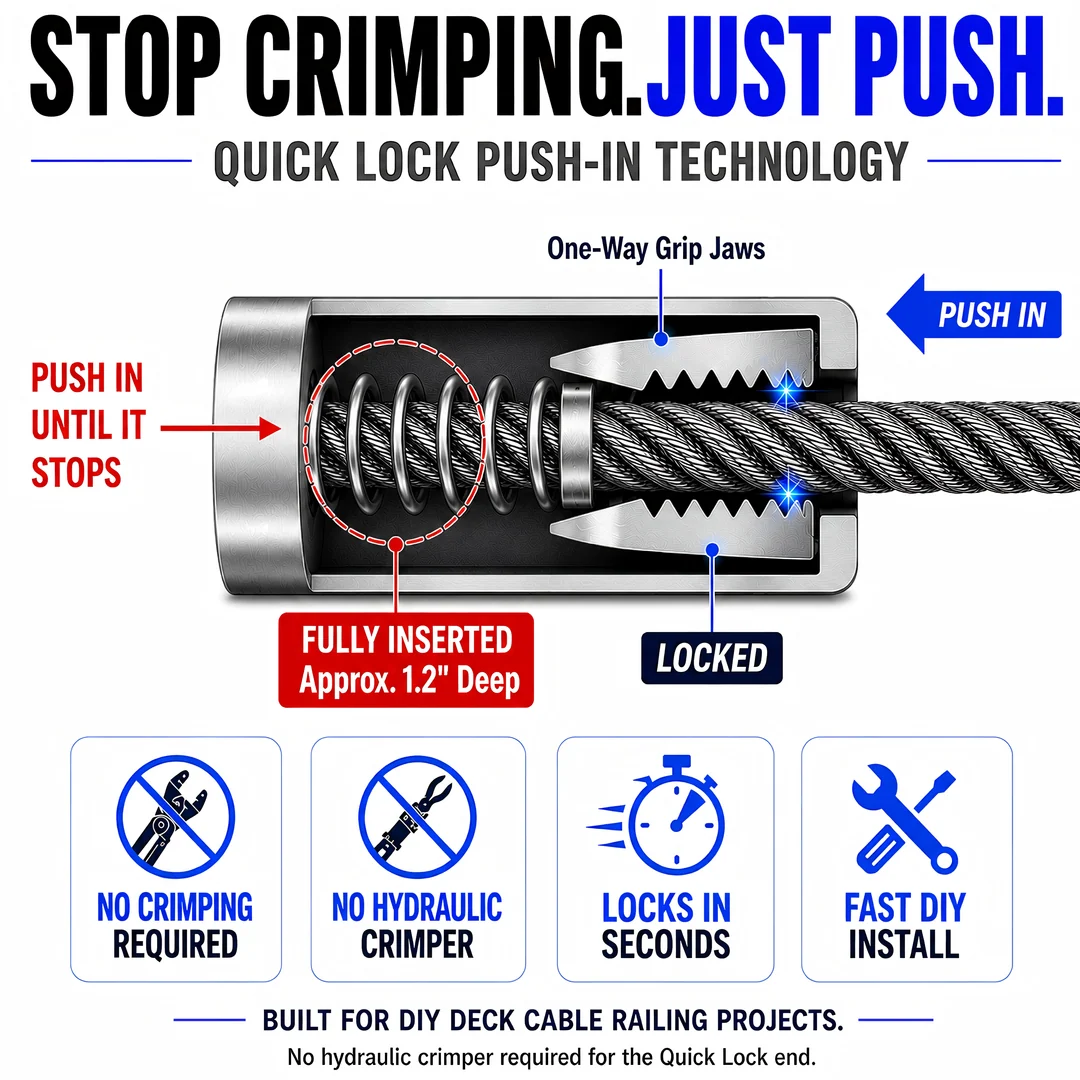
A Quick Lock cable railing fitting is MR.RAIL's push-in, swageless connection for terminating stainless steel cable without hydraulically crimping the Quick Lock end. The prepared cable is pushed fully into the fitting, where internal one-way grip jaws engage the cable. The connection is then used as part of the selected tensioning arrangement for the run.
That short definition answers what the fitting does, but it does not tell a buyer whether a specific Quick Lock model fits a project. Cable construction, cable diameter, post material, stair or level geometry, and mounting layout must all match. A Quick Lock connection also does not eliminate cable cutting, post preparation, final tensioning, inspection, or the need to follow the current installation instructions.
This guide explains the technology, the MR.RAIL model families, and the information to confirm before ordering.
End functions and project configurations
An Ending secures a cable end without tension adjustment. A Tensioner provides the adjustment for tensioning the run. Ending + Tensioner and Tensioner + Tensioner are both possible configurations, selected for the actual installation and compatible components.
Swageless and Swage describe the cable connection, not the number of tensioning ends. Push-in locking does not replace final tensioning.
Standard model layouts are reference configurations, not a requirement to buy one fixed pair. MR.RAIL reviews standardized products, compatible component combinations and project-specific customization. Confirm the cable, post interfaces, adjustment access, exact components and quantities before ordering.
Illustrated reference configurations:
Quick Lock is a type of swageless connection
“Swageless” describes a cable connection installed without conventional swaging equipment. It is a category, not a universal mechanism. MR.RAIL Quick Lock uses its own push-in gripping arrangement; cable construction, diameter, mounting and end function still need to be specified separately.
MR.RAIL Quick Lock is a push-in version of that category. Its key customer-facing characteristics are:
- The cable pushes into the Quick Lock end.
- Internal one-way grip jaws hold the cable after full insertion.
- A hydraulic crimper is not required for the Quick Lock connection.
- MR.RAIL Quick Lock products accept 1×19 stainless steel cable only.
- The model and size family must match the post, run type, mounting layout, and cable diameter.
These statements apply to MR.RAIL Quick Lock products. Use the original MR.RAIL installation instructions for the selected model, including post preparation, access and final tensioning. Another brand's specifications are not installation instructions for an MR.RAIL fitting.
How does the push-in grip work?
At the Quick Lock end, a cleanly prepared cable enters the fitting and passes through the internal gripping section. One-way jaws allow insertion in the intended direction and engage the cable against reverse movement. The cable must be inserted fully according to the approved installation instructions; a partially inserted cable should not be treated as a completed connection.
After the cable is positioned, the other components in the selected product arrangement are used to complete and tension the run. “Push in” describes the Quick Lock termination step. It does not mean the complete railing run is installed or tensioned in one motion.
This distinction matters when comparing product photographs. A fitting may contain a Quick Lock connection and also contain threads, a mounting plate, a post attachment, or a separate tension-adjustment section. Those features define how the complete model attaches and how final tension is applied. Buyers should compare the whole product architecture, not only the visible cable entry.
What cable works with MR.RAIL Quick Lock?
MR.RAIL Quick Lock requires 1×19 stainless steel cable. Cable diameter and cable construction are separate specifications: a cable described as 1/8 inch still needs to be confirmed as 1×19 before it is paired with a Quick Lock product.
- MR-01 through MR-06: 1/8-inch Quick Lock fittings.
- MR-11 through MR-16: 5/32-inch Quick Lock fittings.
- MR-21 through MR-26: 3/16-inch Quick Lock fittings.
The last digit identifies the corresponding application category across the three diameter families. For example, MR-01, MR-11, and MR-21 are the wood-post stair-run Quick Lock category in three different cable sizes. The products are size-specific; they are not one adjustable fitting for all three diameters.
Do not use 7×7 cable with MR.RAIL Quick Lock products. MR.RAIL Swage products accept compatible 1×19 or 7×7 cable in the matching size. If the cable construction is unknown, check the cable manufacturer's label, purchasing record, or approved project specification before ordering the fitting.
Which Quick Lock model fits the post and run?
The connection technology is only the first selection layer. MR.RAIL separates Quick Lock products by post material, run geometry, and mounting arrangement.
Wood-post surface-mount applications
MR-01 / MR-11 / MR-21 are the Quick Lock family for wood-post stair and angled runs. MR-02 / MR-12 / MR-22 are for wood-post level and straight runs. Stair hardware accommodates the angled cable path, while level hardware is selected for a horizontal run.
Metal-post surface-mount applications
MR-03 / MR-13 / MR-23 are the Quick Lock family for metal-post stair and angled runs. MR-04 / MR-14 / MR-24 are for metal-post level and straight runs. A similar appearance does not make the wood-post and metal-post attachment methods interchangeable.
Through-post applications
MR-05 / MR-15 / MR-25 are through-post Quick Lock products for stair runs. MR-06 / MR-16 / MR-26 are through-post Quick Lock products for level runs. A through-post plan should confirm the approved hole arrangement, cable path, access conditions, and the requirements of the selected post before work begins.
What does “no crimping on the Quick Lock end” mean?
It means the installer does not hydraulically compress the Quick Lock fitting onto the cable. That can reduce the specialized equipment needed at that end and can simplify field termination when the fitting, cable, and application all match.
It does not mean “no tools,” “no preparation,” or “automatic completion.” A project may still require tools for measuring, cutting cable cleanly, preparing and drilling posts, attaching hardware, adjusting components, and applying final tension. The exact tool list depends on the selected model and the approved installation instructions.
It also does not establish suitability for a project by itself. The completed guard or railing is a system containing posts, cable, terminations, anchors, intermediate supports, and installation details. Project design and applicable local requirements must be handled separately from the marketing description of one fitting.
Can the cable be repositioned after insertion?
MR-09, MR-19, and MR-29 are matching Quick Lock release tools for the three cable-size families. They can be used to reposition or remove cable from the corresponding MR.RAIL Quick Lock product before final tensioning, following the applicable instructions.
These items are accessories, not cable tensioners. They are not used on the Swage connection, and they should not be presented as a way to reverse a finished installation after final tensioning. The correct release tool must match the product's size family.
For installers, the practical lesson is to verify routing, component orientation, cable length, and fitting choice before final tensioning. The release tool supports a defined pre-tension adjustment step; it is not a substitute for planning.
A six-point Quick Lock buying check
Before requesting a quote or placing an order, record these details for every cable run:
- Cable diameter: 1/8, 5/32, or 3/16 inch.
- Cable construction: Confirm 1×19 for Quick Lock.
- Post material: Wood or metal.
- Run geometry: Stair or angled, or level and straight.
- Mounting layout: Surface-mount or through-post.
- Connection plan: Confirm the fitting used at each end of the cable run.
Also confirm quantities by exact model, access at the end posts, the approved installation manual, and any project-specific drawings. OEM and distributor inquiries should identify the desired packaging, labeling, and documentation rather than assuming those details from a retail image.
When is Quick Lock a practical choice?
Quick Lock is a practical candidate when the project uses 1×19 stainless steel cable, a matching MR.RAIL model exists for the cable diameter and layout, and avoiding hydraulic crimping at the Quick Lock connection is useful to the installation plan.
Swage may be the appropriate category when the project uses 7×7 cable or when a permanent crimped workflow is already specified and supported by the correct equipment.
The right decision comes from the full set of project inputs. If cable construction, post type, run geometry, or mounting arrangement is uncertain, confirm those items before choosing a model. That small specification step prevents a familiar ordering error: selecting a product by connection name while overlooking the rest of the system.
Frequently asked questions
Is Quick Lock the same as a swage fitting?
No. Quick Lock is a swageless push-in connection. A Swage connection is permanently compressed onto the cable with the specified crimping equipment.
Does MR.RAIL Quick Lock accept 7×7 cable?
No. MR.RAIL Quick Lock products accept 1×19 cable only. The MR.RAIL Swage family accepts 1×19 or 7×7 cable in the matching diameter.
Do I need a hydraulic crimper for Quick Lock?
Not for the Quick Lock connection. Other project steps still require the appropriate tools.
Are MR-09, MR-19, and MR-29 tensioners?
No. They are release tools for pre-final-tension repositioning or cable removal in the corresponding Quick Lock size family.
What should I send with a product inquiry?
Send the cable diameter and construction, post material, stair or level condition, surface-mount or through-post layout, quantities, and drawings or photographs when available.