A cable railing tensioner is the adjustable fitting that helps remove slack and complete final tensioning on a cable run. Selecting it correctly requires more than matching a product photograph. The cable construction, cable diameter, post material, stair or level condition, mounting arrangement and opposite cable end must work together.
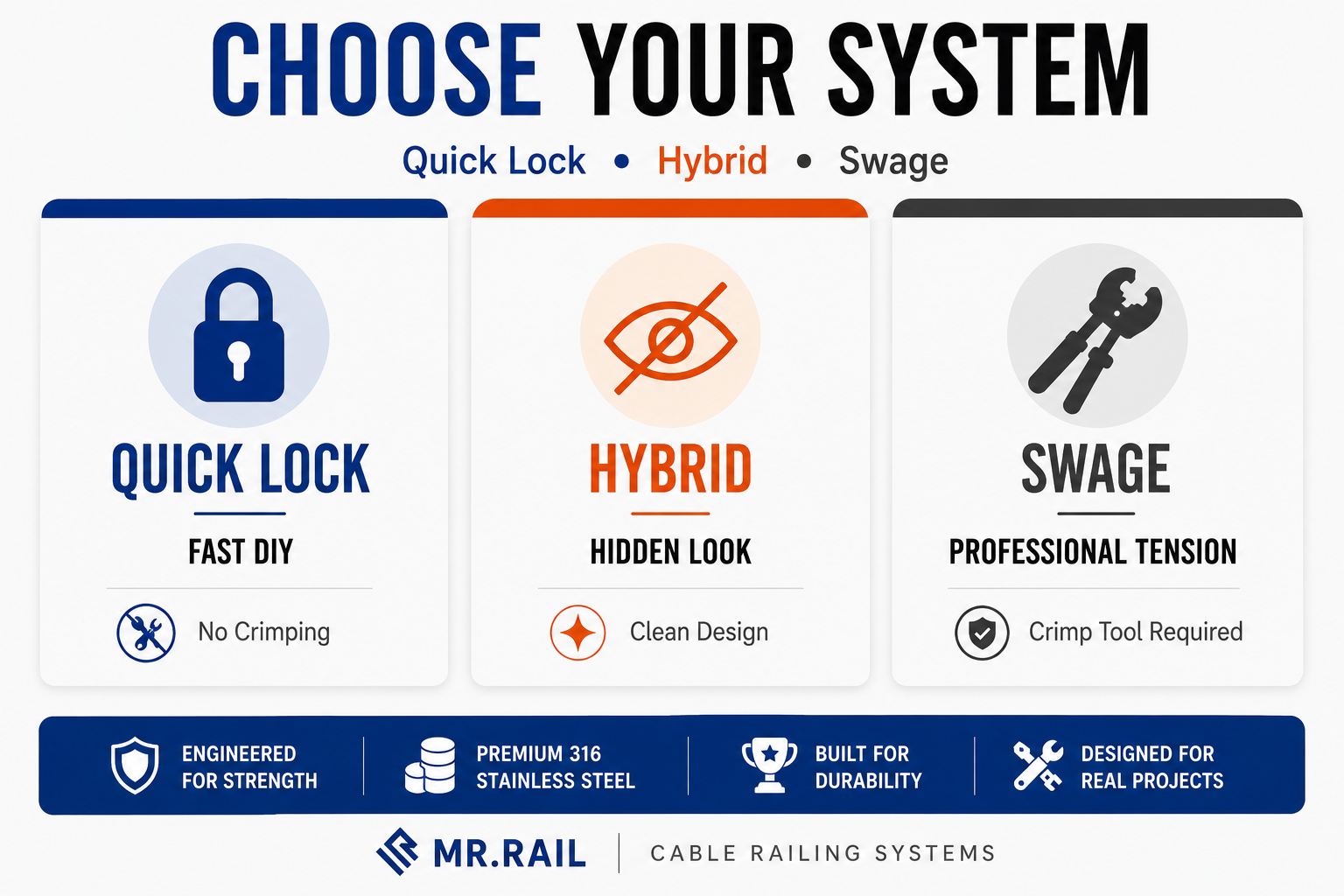
MR.RAIL organizes its standard tensioning hardware around those project inputs. Quick Lock families use a push-in connection for matching 1×19 cable. The Swage family uses a permanent crimped connection and accepts matching 1×19 or 7×7 cable. Both connection types are offered as size-coded families for 1/8, 5/32 and 3/16-inch cable.
This page helps purchasers, contractors, distributors and DIY users identify the correct product family before requesting a quote. It is not a structural design, load calculation or substitute for the current model manual. Confirm the approved installation details for the complete railing project.
What does a cable railing tensioner do?
A cable run needs an adjustable end condition so the installer can take up slack after the cable and termination hardware are positioned. The tensioner provides that adjustment. The opposite end may be a corresponding non-tensioning termination or another adjustable fitting, depending on the manufacturer's product architecture and the approved project layout.
Feeney's current CableRail product guide separates tension-adjustment fittings from fixed-end fittings and explains that an adjustable fitting may be paired with a fixed end or another adjustable fitting. Ultra-tec likewise publishes different tensioning and non-tensioning products for specific post, run and cable conditions. These examples show why “tensioner” describes a function, not a universal part specification (Feeney; Ultra-tec).
For MR.RAIL, the tensioning function is integrated into model-specific hardware arrangements. Do not substitute a fitting because its body shape looks similar. An angled wood-post Quick Lock family, a straight metal-post family and a through-post family solve different attachment and access conditions.
Also separate a tensioner from a service tool. MR-09, MR-19 and MR-29 are release tools for repositioning or removing cable from compatible Quick Lock hardware before final tensioning. They do not create cable tension and are not used with Swage connections.
Choose the connection method before the model
Quick Lock swageless tensioning hardware
MR.RAIL Quick Lock is a push-in connection. After the correct cable is cut and prepared, it is inserted fully into the Quick Lock fitting, where internal one-way grip jaws engage it. A hydraulic crimper is not required on the Quick Lock connection. The fitting still has to be attached to the correct post arrangement and the run still requires final tensioning with the appropriate adjustment feature.
Quick Lock accepts matching-diameter 1×19 cable only. The standard catalog includes surface-mount and through-post arrangements for wood and metal posts, with separate families for stair or angled runs and level or straight runs. Read the Quick Lock technical guide for the connection sequence and selection boundaries.
Permanent Swage tensioning hardware
MR.RAIL Swage hardware uses a permanent crimped cable connection. The cable end is positioned in the Swage section and secured with the specified hydraulic crimping workflow before final tensioning. The MR-08 / MR-18 / MR-28 family is the standard surface-mount Swage choice for wood-post stair or level runs and uses swivel bases to follow the run direction.
The Swage family accepts matching-diameter 1×19 or 7×7 cable. Because the crimp is permanent, cable identity, length, fitting orientation and tool compatibility should be confirmed before that connection is made. The Swageless versus Swage comparison explains the difference without assuming one method fits every project.
Match cable construction and diameter separately
“Cable size” is incomplete unless it identifies both the outside diameter and the strand construction. A 1/8-inch cable may be 1×19, 7×7 or another construction. Sharing a diameter does not make those cables interchangeable inside a termination.
- Quick Lock: matching-diameter 1×19 cable only.
- Swage: matching-diameter 1×19 or 7×7 cable.
MR.RAIL uses the first digit of the model family to identify the standard diameter group. MR-01 through MR-09 are the 1/8-inch family. MR-11 through MR-16, MR-18 and MR-19 are the 5/32-inch family. MR-21 through MR-26, MR-28 and MR-29 are the 3/16-inch family.
The same application category appears across all three sizes. For example, MR-02, MR-12 and MR-22 are the wood-post level-run Quick Lock category in three different diameters. They are separate size-specific models. Use the fitting-size guide to check the complete family map before ordering.
Classify the post, run and mounting method
After the cable is confirmed, identify how the fitting connects to the project. Wood-post and metal-post surface-mount hardware use different attachment arrangements. Stair and angled runs need a fitting category that follows the cable direction, while level and straight runs use a straight configuration.
Mounting access is another separate decision. Surface-mount fittings attach at the post face. Through-post fittings pass through a prepared end-post opening and require the approved access and hardware arrangement. A project may use several families when it includes a deck level, stair flight and a different end-post condition.
Do not order every run from one representative photograph. Separate the takeoff into wood versus metal, stair versus level, surface mount versus through post, and cable diameter. Drawings or clear photographs can help confirm unusual post conditions, but they should accompany the written cable and application specification.
MR.RAIL tensioner family selection matrix
| Model families | Post | Run | Mounting | Connection |
|---|---|---|---|---|
| MR-01 / MR-11 / MR-21 | Wood | Stair or angled | Surface mount | Quick Lock |
| MR-02 / MR-12 / MR-22 | Wood | Level or straight | Surface mount | Quick Lock |
| MR-03 / MR-13 / MR-23 | Metal | Stair or angled | Surface mount | Quick Lock |
| MR-04 / MR-14 / MR-24 | Metal | Level or straight | Surface mount | Quick Lock |
| MR-05 / MR-15 / MR-25 | Wood or metal | Stair or angled | Through post | Quick Lock |
| MR-06 / MR-16 / MR-26 | Wood or metal | Level or straight | Through post | Quick Lock |
| MR-08 / MR-18 / MR-28 | Wood | Stair or level | Surface mount | Swage |
The matrix identifies product families, not package contents. Confirm the exact fitting quantity, opposite-end hardware, cable, tools, post-preparation details and approved instructions for the quotation and installation.
A practical tensioner ordering workflow
- Record the cable construction. Confirm 1×19 or 7×7 from the cable label, purchase record or approved specification.
- Record the cable diameter. Select the 1/8, 5/32 or 3/16-inch MR.RAIL family that matches the cable.
- Separate post materials. List wood-post and metal-post cable runs independently.
- Separate run geometry. Count stair or angled runs separately from level or straight runs.
- Confirm mounting access. Identify surface-mount and through-post end conditions before choosing the family.
- Select Quick Lock or Swage. Match the connection workflow and cable compatibility instead of choosing by appearance.
- Confirm exact quantities. State model families, run counts, requested packaging and any cable or tool scope in writing.
- Use the current instructions. Review the model manual before preparing posts, cutting cable or making a permanent connection.
For OEM, private-label, wholesale or project inquiries, include the destination, model-by-model quantity, packaging and labeling request, and documentation requirements. Price, MOQ, inventory, carton information, trade terms and lead time should come from the current quotation rather than a general web page.
Frequently asked questions
What cable works with an MR.RAIL Quick Lock tensioner?
Use matching-diameter 1×19 stainless steel cable only. Confirm both the cable construction and the diameter family before selecting the model.
What cable works with an MR.RAIL Swage tensioner?
MR.RAIL Swage hardware accepts matching-diameter 1×19 or 7×7 stainless steel cable.
Which MR.RAIL tensioners are for wood posts?
MR-01 / MR-11 / MR-21 cover wood-post stair or angled runs, while MR-02 / MR-12 / MR-22 cover wood-post level or straight runs. MR-08 / MR-18 / MR-28 are the surface-mount Swage family for wood-post stair or level runs.
Which MR.RAIL tensioners are for metal posts?
MR-03 / MR-13 / MR-23 cover metal-post stair or angled runs, and MR-04 / MR-14 / MR-24 cover metal-post level or straight runs. The through-post Quick Lock families may be used with the approved wood- or metal-post arrangement.
Are MR-09, MR-19 and MR-29 tensioners?
No. They are release tools for the matching Quick Lock cable-size families. They support adjustment or cable removal before final tensioning.
Does the word tensioner mean a complete cable railing kit?
No. A tensioner is hardware within a cable run. Cable, posts, handrail, tools, quantities and package contents must be confirmed separately.